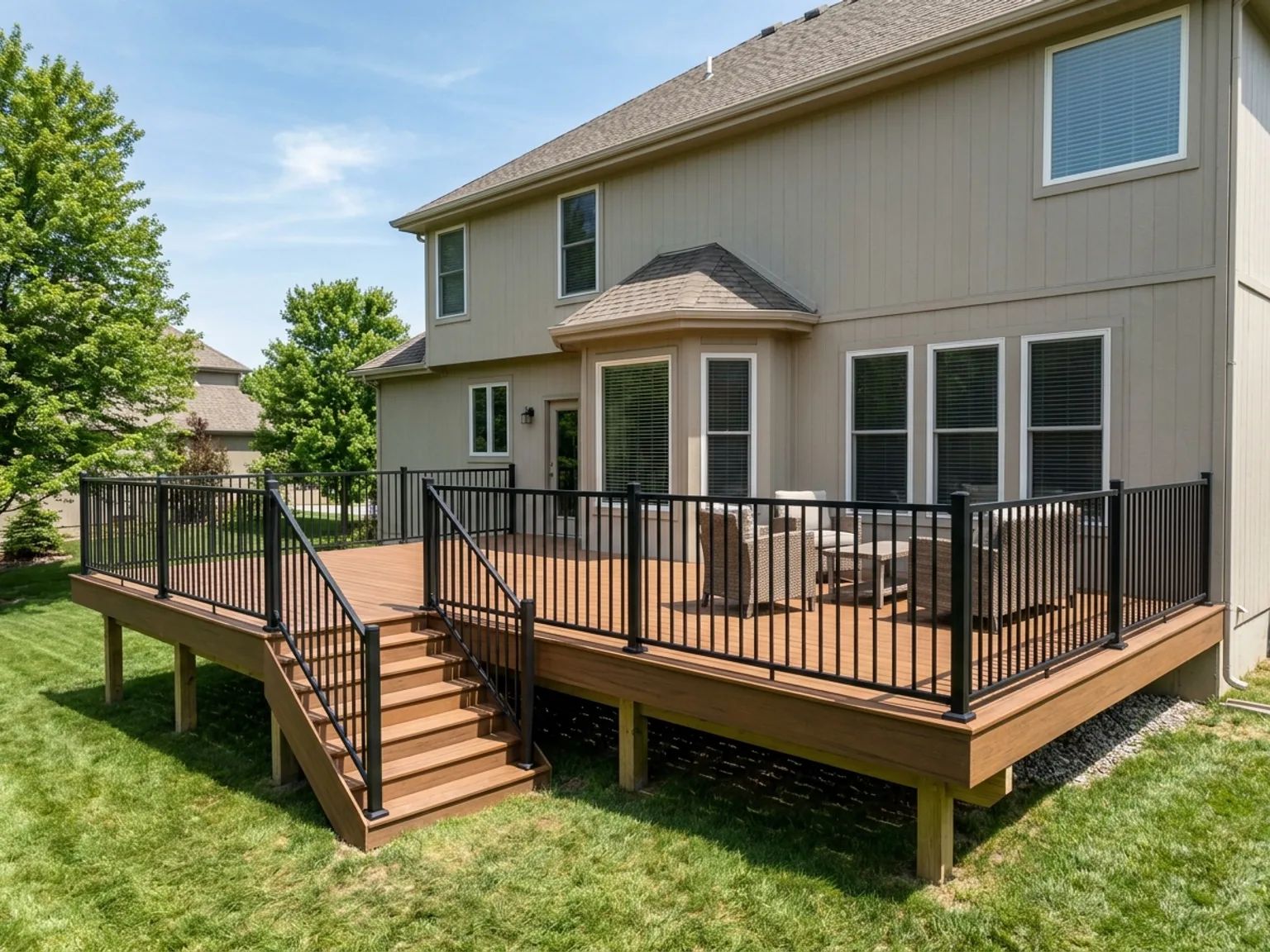
Key Takeaways
- Cost (KC): Concrete patio $12-$23/sq ft, pavers $25-$50; wood deck $30-$60/sq ft, composite $45-$85
- ROI: Wood decks recoup ~80% nationally, composite ~65-70%, patios ~50-70% — but patios risk fewer total dollars
- Site: Flat yard favors a patio; sloped yard or elevated walkout door favors a deck
- KC climate: Freeze-thaw cracks concrete; pavers flex; decks ride above it on frost-depth footings but wood needs stain
- Verdict: Deck for slope and walkout access, patio for budget and longevity — and hybrid deck-plus-patio designs often beat both
Deck or patio is usually the first fork in the road for any backyard project, and I'll be upfront: there is no universal winner. The right answer falls out of three things — your budget, your lot, and how you want to live outside. Get those straight and the decision mostly makes itself.
I'm a 4th-generation Kansas City contractor. My team builds decks and patios in roughly equal numbers across the metro, so I have no thumb on the scale. Below is what each actually costs here, what the resale data says, how our freeze-thaw winters treat each one, and a decision framework at the end.
Cost Per Square Foot in Kansas City
Here are the installed ranges we see across KC-metro projects. National guides like HomeGuide's deck vs patio comparison and Decks.com's cost breakdown show similar spreads, though local footing depth and site access shift the numbers.
Patio (Installed)
$12 - $50 / sq ftPlain concrete sits at $12-$23/sq ft, stamped concrete at $18-$33, and pavers or natural stone at $25-$50. A typical 300-sq-ft concrete patio lands around $4,000-$7,000; the same footprint in pavers runs $8,000-$15,000.
Price drivers:
- • Material: concrete vs stamped vs pavers
- • Grading, drainage, and retaining walls
- • Curves, borders, and integrated features
Lifespan
30-50+ years
Best for
Flat yards, tighter budgets, fire pits and heavy features
Deck (Installed)
$30 - $85 / sq ftPressure-treated wood runs $30-$60/sq ft installed; composite runs $45-$85. A typical 300-sq-ft deck lands around $12,000-$18,000 in wood or $16,000-$26,000 in composite. See our deck cost guide for Kansas City for a full breakdown by size and material.
Price drivers:
- • Decking material and railing choice
- • Height above grade and stairs
- • Built-ins, lighting, and pergolas
Lifespan
15-25 yrs wood; 25-50 composite
Best for
Sloped lots, walkout doors above grade, views
If you're weighing wood against composite for the deck side of this decision, our composite vs wood deck cost comparison digs into that trade-off. And if stamped concrete caught your eye as the patio middle option, our stamped concrete patio cost guide covers local pricing pattern by pattern.
ROI & Resale: What the Data Says
Decks are the resale star of this matchup. National cost-vs-value tracking consistently puts wood deck additions among the top exterior projects, recouping roughly 80% of their cost at resale, with composite decks around 65-70%. Patios typically recoup 50-70%. Industry comparisons like Trex's deck vs patio guide reach the same conclusion, even accounting for the source's deck-side bias.
But percentage ROI is only half the story. A $6,000 concrete patio that recoups 60% costs you $2,400 net; a $20,000 composite deck that recoups 68% costs you $6,400 net. Both make the home easier to sell. In the KC market, what buyers really respond to is a finished, intentional outdoor space — an empty back door with a stoop is the thing that hurts you. My honest read after years of building both: pick the structure that fits your lot and your life, and resale will take care of itself.
Site Considerations: Grade, Height & Soil
This is the factor most homeowners underweight, and it's often the one that decides the project.
Grade (slope): patios need a level, compacted base. On a flat lot that's cheap; on a sloped KC backyard it means cut-and-fill grading and often retaining walls that can add $5,000-$20,000. Decks ride over slope on posts — a hillside barely changes the price.
Door height: if your back door sits two or more feet above grade — extremely common in KC homes with basements — a deck meets the door where it is. A patio at ground level leaves you building stairs down and living with a disconnected space. Walkout-basement lots flip this: the upper level wants a deck, the lower level wants a patio underneath.
Soil: much of the metro sits on expansive clay that swells when wet and shrinks when dry. Slabs poured on poorly prepared clay settle and crack; a proper granular base and drainage plan are non-negotiable for patios here. Decks are more forgiving because their footings bear below the active soil zone at frost depth (36 inches).
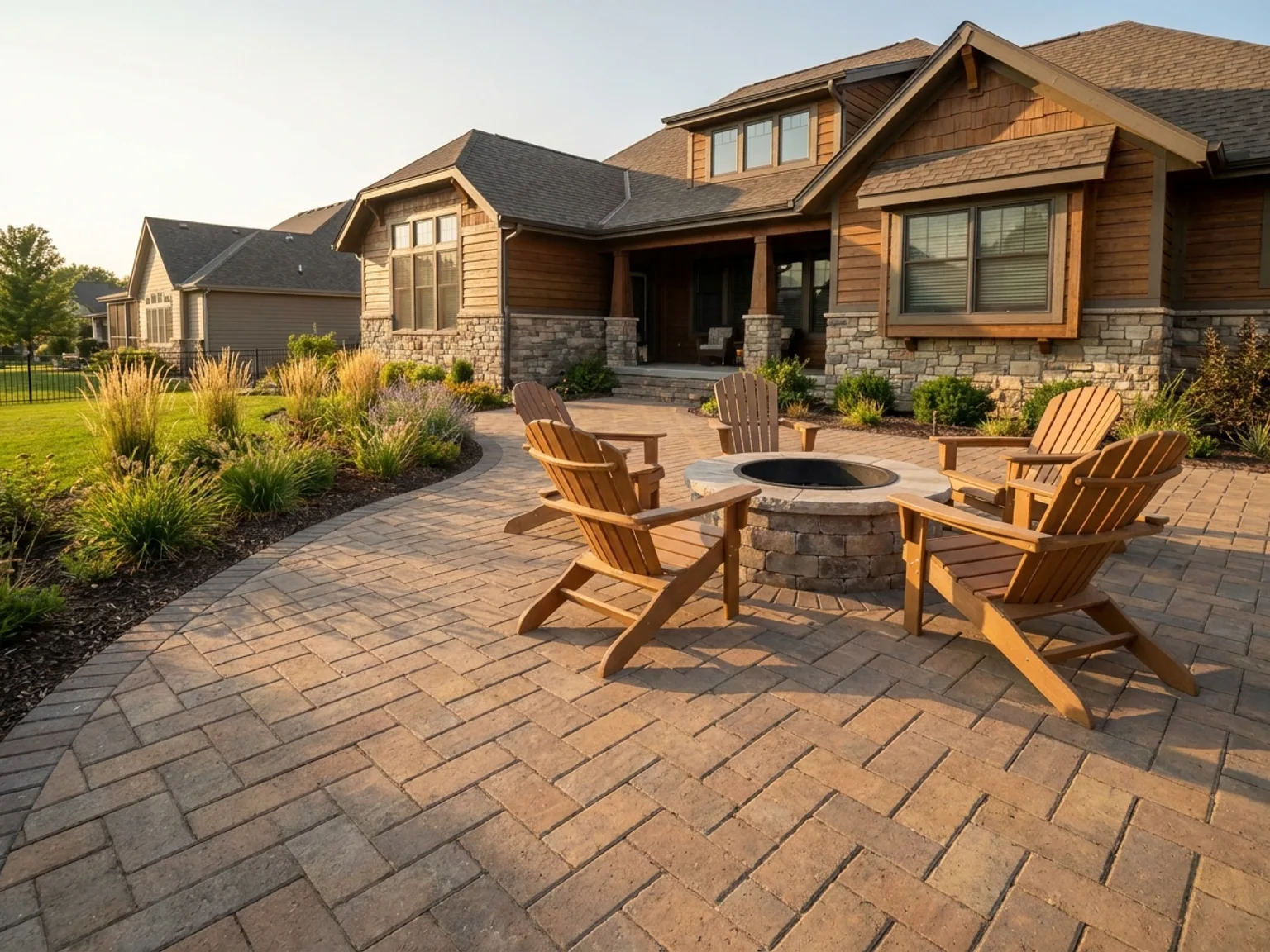
Kansas City Freeze-Thaw: The Local Wildcard
KC cycles above and below freezing dozens of times each winter, and that expansion-contraction cycle is the single hardest thing our climate does to outdoor construction.
Concrete patios take the worst of it. Water works into the slab, freezes, expands about 9%, and over years that means cracking and surface spalling. Good practice fights back: air-entrained concrete, a compacted granular base, control joints, and sealing every 2-3 years. Done right, a KC slab lasts decades; done cheap, it cracks in three winters.
Paver patios handle freeze-thaw the best of any hardscape because they're a flexible system — thousands of jointed units over a compacted base that move a fraction of an inch with the ground and settle back. If a section ever heaves, you lift and re-lay it invisibly.
Decks mostly opt out of the problem: the structure stands on footings below frost depth, so ground movement doesn't touch it. The trade is that wood decking endures the moisture swings directly and needs stain or sealer on a 2-3 year cycle; composite decking sidesteps that too.
Maintenance Compared
Ranked from most to least demanding: wood decks (wash and re-stain every 2-3 years, plus board and fastener repairs), concrete patios (reseal every 2-3 years, patch cracks), paver patios (top up joint sand, spot-treat weeds), composite decks (soap and water). Over a 20-year horizon, a wood deck's upkeep can add $3,000-$6,000; a paver patio's might be a few hundred dollars.
| Factor | Deck | Patio |
|---|---|---|
| Installed Cost (KC) | $30 - $85 / sq ft | $12 - $50 / sq ft |
| ROI at Resale | ~65-80% | ~50-70% |
| Sloped Lots | Excellent (rides on posts) | Needs grading / retaining walls |
| Freeze-Thaw | Structure immune; wood needs stain | Concrete can crack; pavers flex |
| Maintenance | Stain every 2-3 yrs (wood) | Low (seal or joint sand) |
| Lifespan | 15-25 yrs wood; 25-50 composite | 30-50+ years |
| Permit Required | Yes, nearly always | Usually not (ground level) |
| Heavy Features (fire pit, kitchen) | Needs engineering | Handles them natively |
Choose a Deck If...
- Your yard slopes – posts handle grade changes a patio can't
- Your door sits above grade – the deck meets the house at floor level
- You want the view – elevation buys sightlines over the fence
- Resale percentage matters – wood decks recoup ~80% nationally
Choose a Patio If...
- Budget leads the decision – concrete costs a third of a comparable deck
- Your lot is flat – you get maximum space for minimum dollars
- You want low upkeep and longevity – hardscape outlasts framing
- You're planning heavy features – fire pits and kitchens sit best on grade
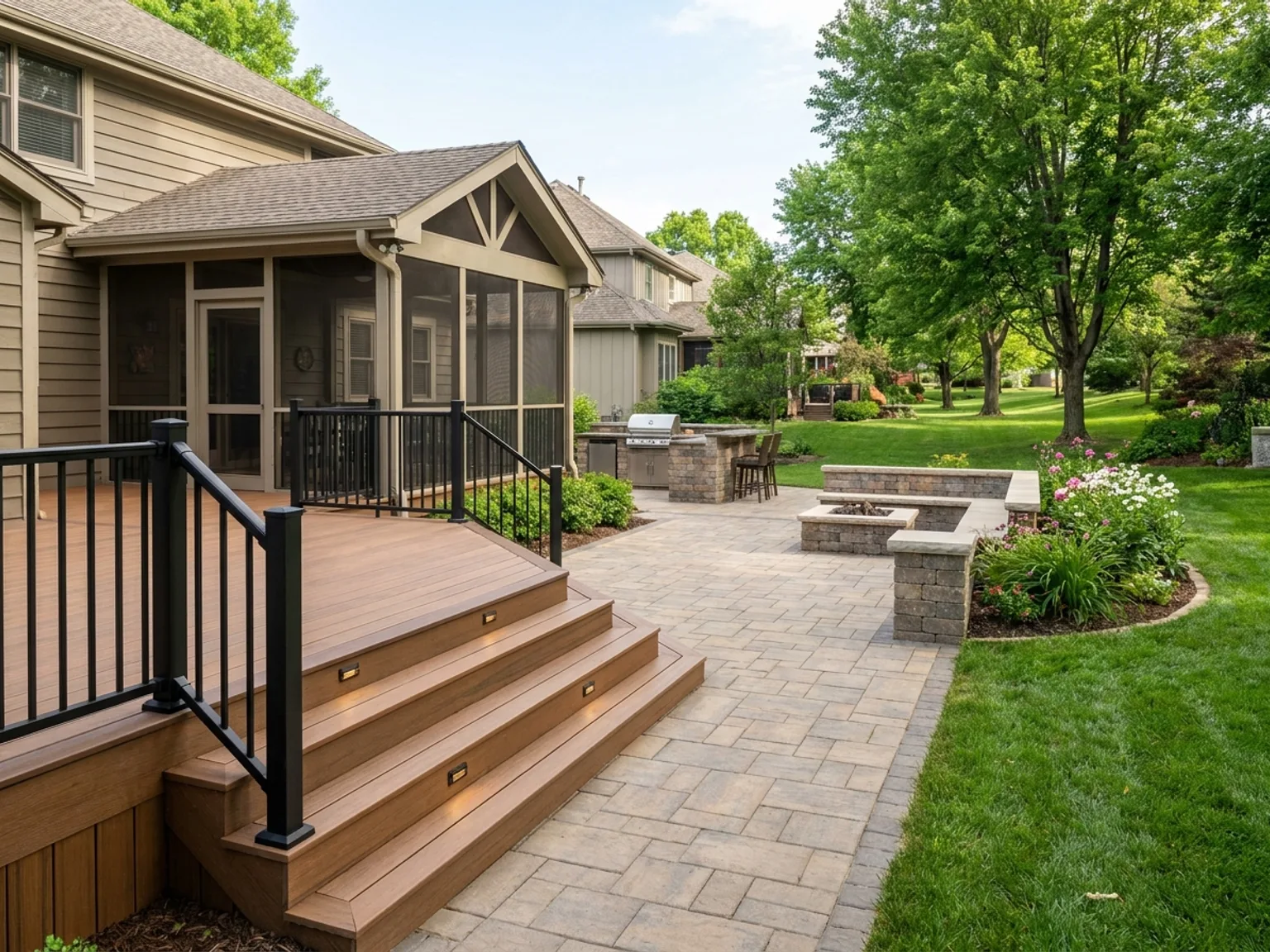
The Hybrid Option: Deck + Patio Together
Here's the part most deck-vs-patio articles skip: the best backyards in the KC metro usually have both. A common layout we build is a composite deck at door level — grilling and dining right off the kitchen — stepping down to a paver or stamped concrete patio with a fire pit, seating wall, or an outdoor kitchen.
The hybrid works because each structure does what it's best at: the deck solves the door-height problem and the patio hosts the heavy, hot, high-traffic features. It also creates distinct zones — dining up top, fire and lounging below — that make even a modest backyard live large. And because patio square footage is cheaper than deck square footage, a 200-sq-ft deck plus 300-sq-ft patio usually costs meaningfully less than a single 500-sq-ft deck.
So Which Should You Choose?
Go deck if: your yard slopes, your back door sits well above grade, or you want the strongest resale percentage. Our deck construction page shows recent wood and composite builds across the metro.
Go patio if: your lot is flat, budget is the driver, or you want a space that outlasts you with minimal upkeep. Our patio construction team builds everything from plain concrete to natural stone, and if you're down to pavers versus concrete, our paver vs concrete patio comparison settles that sub-decision.
Go hybrid if: the budget allows and you want the backyard that does everything. It's the layout we recommend most often when the lot supports it.
Frequently Asked Questions
Is a deck or a patio cheaper to build in 2026?
A patio is almost always cheaper. In Kansas City, a plain concrete patio runs $12-$23 per square foot installed and a paver patio $25-$50, while a pressure-treated wood deck runs $30-$60 per square foot and composite $45-$85. For a typical 300-square-foot space, that often means $4,000-$10,000 for concrete versus $12,000-$25,000 for a deck. The main exception is a sloped yard, where the grading and retaining walls a patio needs can erase its price advantage.
Which has better ROI, a deck or a patio?
Wood decks post some of the strongest resale numbers of any exterior project, recouping roughly 80% of their cost in national cost-vs-value data, with composite decks around 65-70%. Patios typically recoup 50-70%. But because patios cost so much less up front, the total dollars at risk are smaller, and a well-designed patio in a flat KC backyard is still an excellent investment. ROI favors decks; total out-of-pocket favors patios.
How does Kansas City's freeze-thaw climate affect each option?
KC swings through dozens of freeze-thaw cycles each winter. Concrete patios are the most vulnerable: water in the slab freezes, expands, and eventually causes cracking or surface spalling, which is why proper base prep, air-entrained concrete, control joints, and sealing matter so much here. Paver patios flex with the ground and shrug off frost heave. Decks ride above the soil on frost-depth footings (36 inches in the KC area), so the structure itself is largely immune, though wood surfaces need stain and sealer to survive the moisture cycles.
Do I need a permit for a deck or patio in the KC metro?
Decks almost always require a building permit because they are elevated structures with footings, framing, and railing requirements. A ground-level patio usually does not require a permit in most metro cities, unless it involves significant retaining walls or drainage changes. This is one reason patios are often faster to complete: no plan review or framing inspections.
Which is better for a sloped backyard?
A deck, in most cases. Decks are engineered to ride over slopes on posts, so an uneven or steeply graded yard costs little extra. A patio on the same lot needs cut-and-fill grading, and often retaining walls, which can add $5,000-$20,000 or more. As a rule of thumb: the more your yard slopes away from the house, the more the math tilts toward a deck.
How much maintenance does each require?
A wood deck is the most demanding: cleaning and re-staining every 2-3 years, plus periodic board and fastener repairs. Composite decking cuts that to soap-and-water cleaning. Concrete patios need resealing every 2-3 years and occasional crack repair. Paver patios need joint sand refreshed and occasional weed control, but individual pavers can be lifted and replaced, which makes repairs nearly invisible.
How long do decks and patios last?
A well-built pressure-treated deck lasts 15-25 years with maintenance; composite decks routinely carry 25-50-year warranties on the boards, though the wood substructure remains the limiting factor. A properly poured concrete patio lasts 30+ years, and a paver patio can last 50+ because individual units are replaceable. On pure longevity, hardscape wins.
Can I combine a deck and a patio?
Yes, and it is one of the best-performing designs we build. A common KC layout is a composite deck at door level stepping down to a paver or stamped-concrete patio with a fire pit or outdoor kitchen. You get the deck's walkout convenience and the patio's durability for heavy features, and the two zones make the whole backyard feel intentional. Budget-wise it is usually cheaper than building one giant deck of the same total footprint.
Ready to Build Your Outdoor Space?
The fastest way to settle deck vs patio is a site visit. We'll look at your grade, your door height, and your soil, then price both options honestly so you can compare real numbers instead of national averages.
We offer free, no-obligation consultations across the Kansas City metro and typically turn around a detailed quote within 24-48 hours. Call (816) 365-9308 or use the form below.
About the Author
Bob Coulston, Owner of Coulston Construction
Bob is a 4th generation contractor who founded Coulston Construction 15 years ago. His team of 30+ employees has completed over 500 projects across the Kansas City metro, including custom decks, concrete and paver patios, and combined outdoor living spaces. The company maintains a 5.0 Google rating with 500+ reviews and an A+ BBB rating.
Learn more about Bob →