Key Takeaways
- $15-$25/sq ft: Pressure-treated lumber (most affordable, needs upkeep)
- $25-$40/sq ft: Cedar (natural beauty, mid-range price)
- $30-$60/sq ft: Composite like Trex / TimberTech (low maintenance, premium)
- 300 sq ft example: $4,500-$7,500 treated, $7,500-$12,000 cedar, $9,000-$18,000 composite
- KC footings: Must go ~36" deep below the frost line for freeze-thaw protection
If you're searching "how much does a deck cost in Kansas City," you've probably found a pile of national averages that don't mean much for our market. The honest answer is that decks are priced by the square foot, and the material you choose sets the range. Let me give you the real local numbers.
I've been building decks in the Kansas City metro for years, from simple pressure-treated platforms in the Northland to elevated composite outdoor living spaces in Leawood. The single most useful number to anchor on is the installed price per square foot. Once you know that, you can estimate almost any deck in your head.
According to the North American Deck and Railing Association (NADRA), a properly built deck is one of the highest-value outdoor improvements you can make. The 2024 Cost vs. Value Report from Remodeling Magazine consistently shows wood decks recouping a strong share of their cost at resale, and our lower Midwest labor rates make that math even better here.
Deck Cost by Material (Price Per Square Foot)
The biggest driver of your deck cost is the decking material. Everything else, including height, railings, and stairs, builds on top of that base. Here's what Kansas City homeowners typically pay per square foot, fully installed:
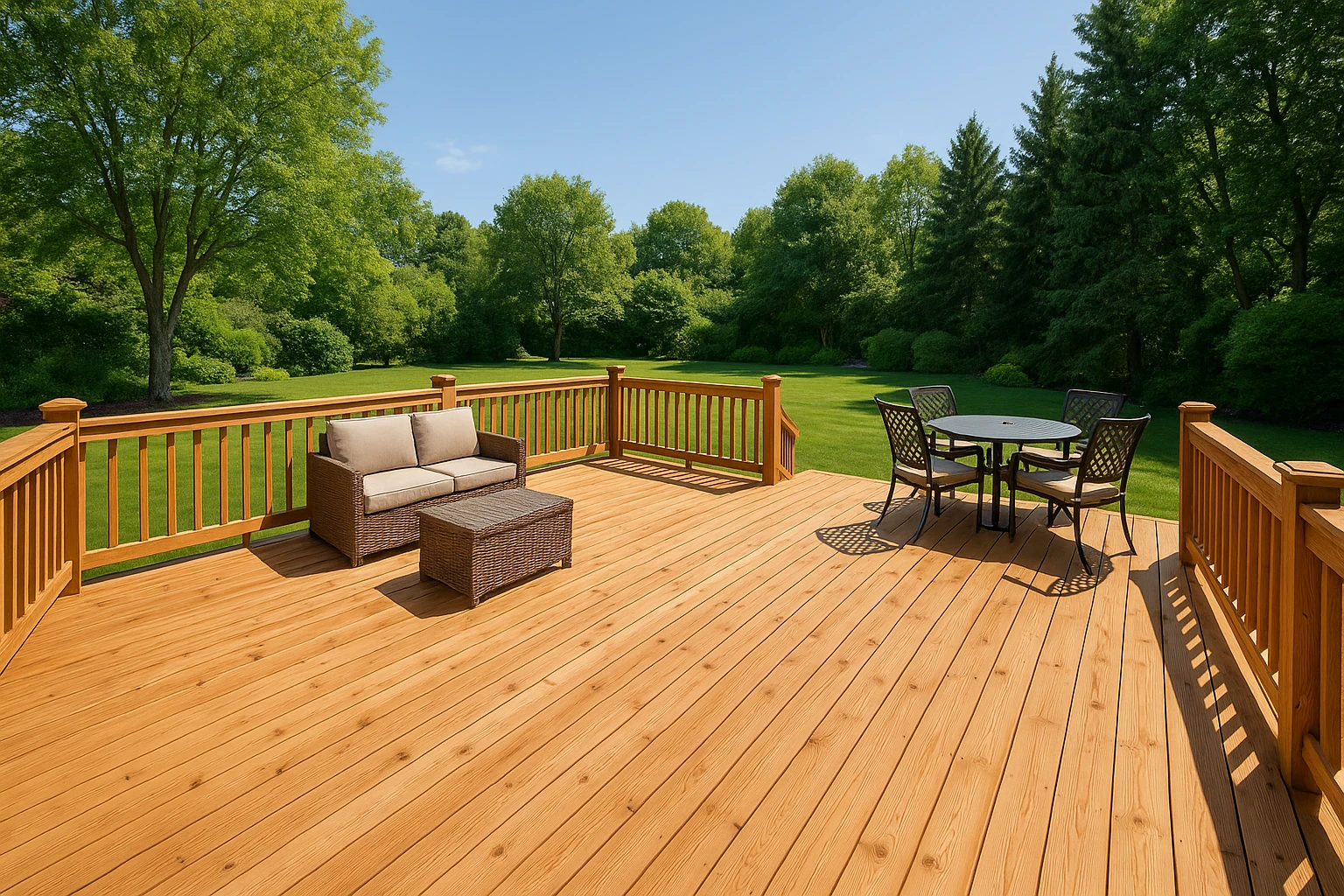
Pressure-Treated Lumber
$15 - $25 / sq ftThe most affordable, most common deck in Kansas City. Strong, weather-resistant, and stains nicely. The tradeoff is maintenance: clean and re-stain every two to three years to keep it looking sharp and prevent warping.
300 sq ft example:
- • Installed total: $4,500 - $7,500
- • Treated pine framing and boards
- • Standard wood railing
- • Needs staining every 2-3 years
Lifespan
15-20 years with upkeep
Best for
Budget-minded homeowners who don't mind maintenance
Cedar
$25 - $40 / sq ftThe sweet spot for a lot of Kansas City homeowners. Cedar has natural beauty, resists rot and insects, and stays cooler underfoot than composite in our summer heat. It still needs periodic sealing, but it looks fantastic doing it.
300 sq ft example:
- • Installed total: $7,500 - $12,000
- • Cedar decking, rich natural grain
- • Upgraded railing options
- • Seal every 2-3 years to keep color
Lifespan
20-25 years with upkeep
Best for
Homeowners who want real wood beauty at a mid-range price
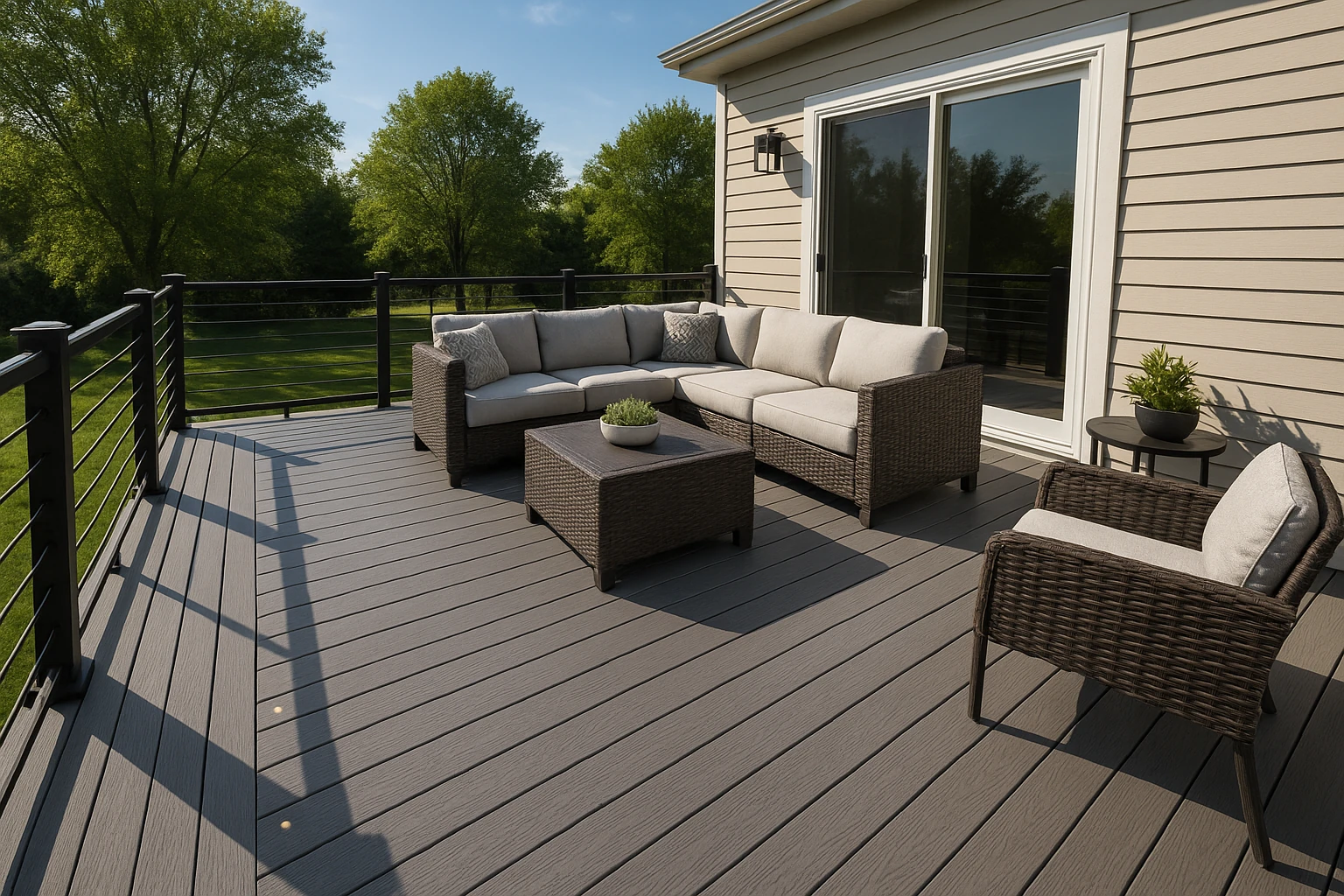
Composite (Trex / TimberTech)
$30 - $60 / sq ftThe premium, low-maintenance choice. Composite never needs staining or sealing, resists fading and stains, and carries long warranties. It costs roughly double pressure-treated up front, but you trade weekend upkeep for decades of easy living.
300 sq ft example:
- • Installed total: $9,000 - $18,000
- • Trex or TimberTech boards
- • Aluminum or composite railing
- • No staining, ever
Lifespan
25-50 year warranties
Best for
Long-term homeowners who never want to refinish a deck
Choosing between wood and composite is the single biggest decision you'll make, and it deserves more than a paragraph. If you're weighing the up-front savings of wood against the lifetime savings of composite, read our dedicated composite vs wood deck comparison for a full side-by-side breakdown of cost over time.
Price Per Square Foot at a Glance
Here's the whole picture in one table. Multiply the per-square-foot range by your deck size for a quick ballpark, then read on for the factors that push you toward the high or low end:
| Material | Per Sq Ft (Installed) | 300 Sq Ft Deck | Maintenance |
|---|---|---|---|
| Pressure-Treated | $15 - $25 | $4,500 - $7,500 | Stain every 2-3 yrs |
| Cedar | $25 - $40 | $7,500 - $12,000 | Seal every 2-3 yrs |
| Composite (Trex / TimberTech) | $30 - $60 | $9,000 - $18,000 | Wash only, no refinishing |
For reference, HomeAdvisor's deck cost data puts the national average for building a deck in a similar range, but national numbers blend high-cost coastal markets with low-cost rural ones. Kansas City sits a bit below the national average thanks to our lower labor rates, which is good news for your budget.
What Actually Drives Your Deck Cost
Two 300-square-foot decks can be thousands of dollars apart. Here's where that difference comes from, and why I always quote a range until I've seen your yard:
Size and height. Bigger decks cost more in total but often a little less per square foot. Height is the bigger swing: a ground-level deck needs minimal railing and short posts, while a second-story deck off a walkout requires tall posts, more framing, code-required railing, and a longer, costlier stair run.
Railings. Railing is one of the most underestimated line items. Basic pressure-treated railing is cheap, but aluminum, cable, or glass railing can add $40-$120 per linear foot. On an elevated deck wrapped on three sides, railing alone can be 15-25% of the total.
Stairs. Every staircase adds framing, treads, footings, and railing. A single short flight might add a few hundred dollars; a long run down from an elevated deck, or multiple staircases, can add $1,500-$4,000.
Foundation and footings. This is the part nobody sees and the part that matters most. In Kansas City, footings have to be dug below the frost line (generally around 36 inches) and properly poured. More posts, deeper footings, and difficult soil or slope all add cost, but cutting corners here is how decks end up heaving and pulling away from the house.
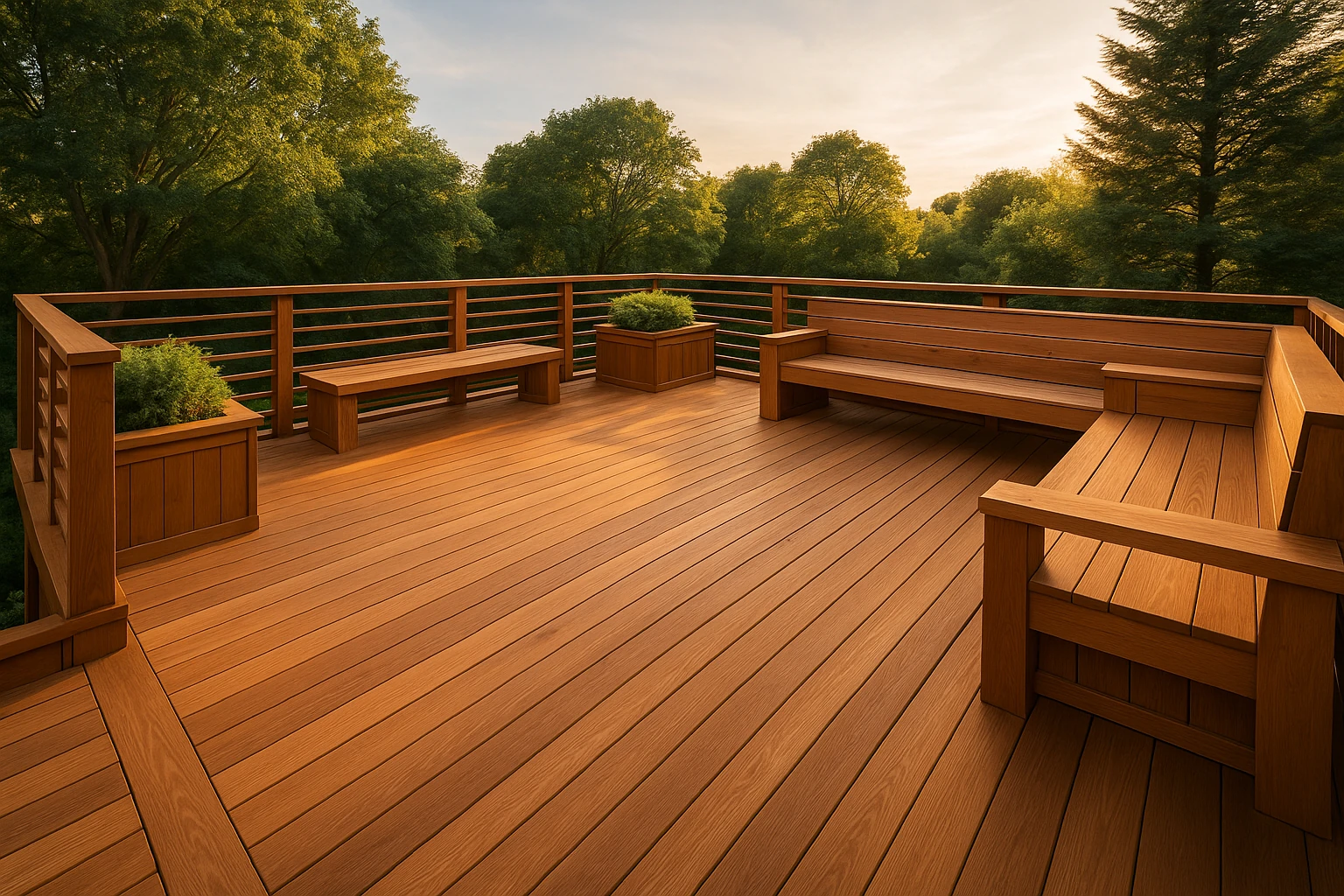
Built-ins and features. Built-in benches, planters, pergolas, lighting, a fire feature, or a multi-level design all add to the bottom line. A custom bench might add $500-$1,500; a pergola or roof can add several thousand. These are where a deck turns into an outdoor living room.
Permits and Footings in Kansas City
Decks are not the place to skip a permit. Most metro municipalities, including Kansas City proper, Overland Park, Lee's Summit, and the Johnson County cities, require a permit for any attached deck or any deck more than 30 inches off the ground, along with inspections of the footings and framing. Permit fees usually run $100-$400. A good contractor handles the permit and inspections so you don't have to.
The freeze-thaw cycle is the reason our footing requirements are stricter than warmer climates. When the ground freezes and thaws repeatedly through a Kansas City winter, shallow footings get pushed up by frost heave. Footings poured below the roughly 36-inch frost line stay put. I've been called out to fix plenty of bargain decks where the footings were too shallow, and the repair almost always costs more than doing it right would have.
Smart Ways to Save Money
Want to stretch your deck budget? Focus on these high-impact choices, and know the few places where saving money backfires:
High-Impact Savings
- Keep the design simple – A single-level rectangle beats curves and corners
- Stay low to the ground – Less railing, shorter posts, fewer stairs
- Choose pressure-treated – $15-$25/sq ft vs $30-$60 for composite
- Limit stairs and railing – Each run and section adds real cost
- Build off-season – Late fall and winter often earn better pricing
Where NOT to Cut Corners
- Footing depth – Shallow footings heave and ruin the deck
- Ledger attachment – A bad ledger can pull off the house
- Permits and inspections – Skipping them risks safety and resale
- The contractor – The cheapest bid often costs more to fix
How Long Does It Take to Build a Deck?
Timeline surprises homeowners almost as much as cost. Here's a realistic breakdown for a typical Kansas City deck:
Design & Quote
3-7 daysSite visit, layout, material selection, and a firm quote
Permits & Material Order
1-3 weeksPull the city permit and order decking, railing, and hardware
Footings & Framing
2-5 daysDig and pour footings below the frost line, set posts and framing
Decking & Railing
3-7 daysLay the decking boards, build stairs, and install railing
Built-Ins & Final Inspection
2-4 daysAdd benches, lighting, or pergola, then pass the final city inspection
Bottom line: Most standard decks take one to two weeks of on-site work, while larger multi-level or elevated decks run two to four weeks. Add one to three weeks up front for design, permitting, and material ordering before the build begins.
Ready to see what your project looks like in practice? Our deck construction page has examples from recent Kansas City builds across every material and budget.
Frequently Asked Questions
How much does a deck cost in Kansas City in 2026?
Deck costs in Kansas City run $15-$25 per square foot for pressure-treated lumber, $25-$40 per square foot for cedar, and $30-$60 per square foot for composite like Trex or TimberTech. For a typical 300-square-foot deck, that means roughly $4,500-$7,500 pressure-treated, $7,500-$12,000 cedar, and $9,000-$18,000 composite, all installed.
How much does a 300 square foot deck cost in Kansas City?
A 300-square-foot deck (a common 12x25 or 15x20 size) runs about $4,500-$7,500 in pressure-treated lumber, $7,500-$12,000 in cedar, and $9,000-$18,000 in composite. The wide range within each material comes from deck height, railing style, number of stairs, and whether you add built-ins.
What is the cheapest decking material?
Pressure-treated pine is the cheapest decking material at $15-$25 per square foot installed in Kansas City. It is strong, holds up to our weather, and accepts stain well. The tradeoff is maintenance: you will need to clean and re-stain it every two to three years to keep it looking good and prevent warping.
Is composite decking worth the extra cost?
For many Kansas City homeowners, yes. Composite costs about twice as much as pressure-treated up front ($30-$60 vs $15-$25 per square foot), but it never needs staining or sealing and carries 25-to-50-year warranties. If you plan to stay in your home long term and hate yard maintenance, the lifetime cost often favors composite.
Do I need a permit to build a deck in Kansas City?
Almost always, yes. Most Kansas City metro municipalities require a building permit for any deck attached to the house or over 30 inches off the ground, and inspections of the footings and framing. Permit costs typically run $100-$400 depending on the city. A reputable contractor pulls the permit and schedules inspections for you.
How deep do deck footings need to be in Kansas City?
In the Kansas City area, deck footings must extend below the frost line, which local code generally sets around 36 inches deep. This protects your deck from frost heave during our freeze-thaw winters. Skipping proper footing depth is the number one reason cheap decks shift, crack, and pull away from the house within a few years.
How long does it take to build a deck?
A standard ground-level deck takes about one to two weeks of on-site work once permits are in hand. Larger, elevated, or multi-level decks with stairs and built-ins run two to four weeks. Add one to three weeks up front for design, permitting, and material ordering before construction starts.
How can I save money on a deck?
The biggest savings come from keeping the design simple: a single-level rectangle with fewer corners is far cheaper than a multi-level or curved deck. Choosing pressure-treated over composite, keeping the deck low to reduce railing and footing work, and minimizing stairs all cut cost. Building during the off-season (late fall or winter) can also earn better pricing.
Ready to Get Started?
Every yard and every deck is different. The per-square-foot numbers in this guide give you a solid starting point, but your home, your slope, and your wish list will determine the final figure.
If you'd like a detailed quote for your deck, we offer free consultations with no obligation. We'll walk your yard, talk through materials and design, and give you a realistic budget range, usually within 24-48 hours.
About the Author
Bob Coulston, Owner of Coulston Construction
Bob is a 4th generation contractor who founded Coulston Construction 15 years ago. His team of 30+ employees has built decks and outdoor living spaces across the Kansas City metro, from budget pressure-treated platforms to premium composite multi-level designs. The company maintains a 5.0 Google rating with 500+ reviews and an A+ BBB rating.
Learn more about Bob →