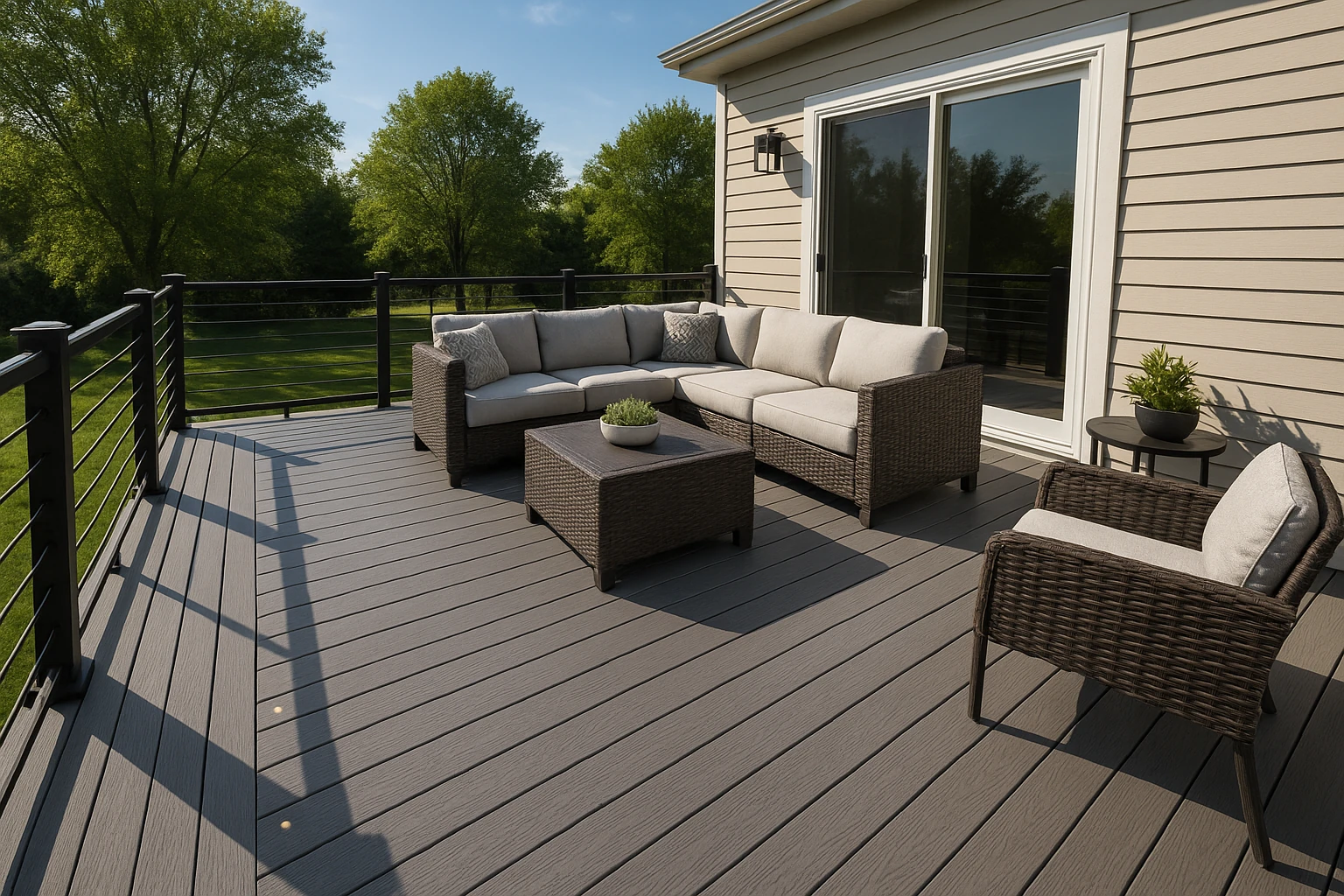
Key Takeaways
- Pressure-treated pine: $15-$25/sq ft installed (cheapest upfront, most maintenance)
- Cedar: $25-$40/sq ft (beautiful real wood, mid maintenance)
- Composite: $30-$60/sq ft (highest upfront, lowest maintenance, 25+ year lifespan)
- Wood upkeep: Staining/sealing every 1-3 years at $2-$4/sq ft
- Verdict: Wood for short stays and tight budgets, composite for the long haul
If you're trying to decide between a composite and a wood deck, the price tag is only half the story. The cheaper deck to build is often the more expensive deck to own, and the opposite can be true too. Here's how the numbers really shake out in Kansas City.
I'm Bob Coulston, a 4th-generation contractor, and my team builds decks all over the KC metro, from Overland Park and Leawood down to Lee's Summit and up into the Northland. I've framed cheap pine decks for folks flipping a house and high-end composite decks for forever homes. The right material depends entirely on your budget and how long you plan to stay.
Our climate makes this decision matter more than it does in milder parts of the country. Kansas City summers are hot and humid, which feeds rot and mildew on wood. Then winter hits with brutal freeze-thaw cycles that pry at every crack and fastener. Whatever you build has to survive 100-degree Julys and ice storms in January, and the two materials handle that very differently.
Deck Cost by Material in Kansas City
Here are the real installed prices I quote in the KC metro. These include framing, fasteners, and labor for a standard ground-level or low deck. Elevated decks, stairs, and railing upgrades add to every one of these.
Pressure-Treated Pine
$15 - $25 / sq ftThe budget workhorse. Cheapest to build, but it demands the most upkeep and has the shortest lifespan of the three.
What you get:
- • Lowest upfront price by far
- • Widely available, easy to repair
- • Needs stain/seal every 1-2 years
- • 10-15 year lifespan in KC weather
300 sq ft total
$4,500 - $7,500
Best for
Tight budgets and short-term ownership
Cedar
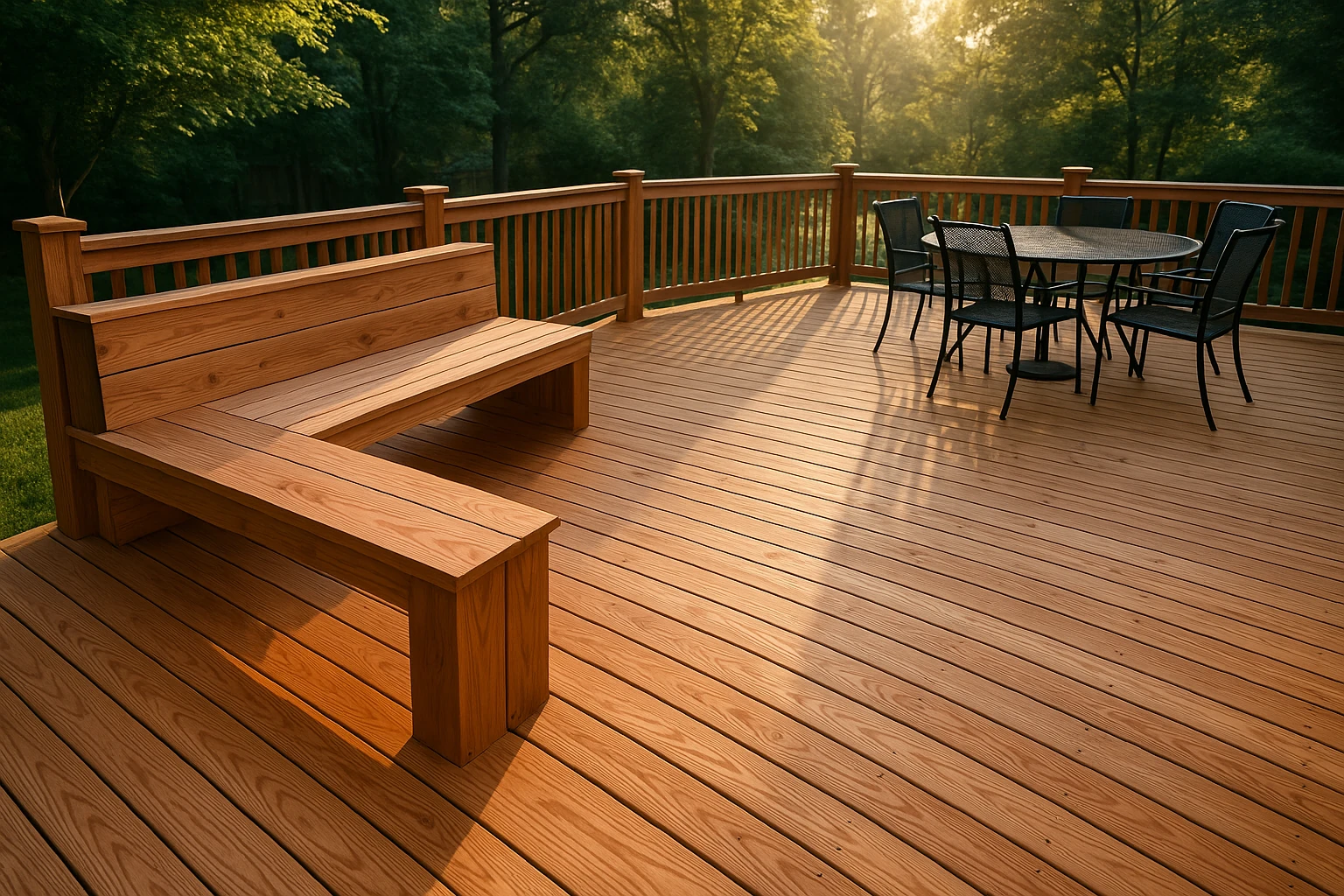
$25 - $40 / sq ftThe beautiful middle ground. Naturally rot- and insect-resistant with a warm look that no composite quite matches, at a mid-range price.
What you get:
- • Gorgeous natural wood grain
- • Naturally resists rot and bugs
- • Stains cooler underfoot than composite
- • 15-20 year lifespan with care
300 sq ft total
$7,500 - $12,000
Best for
Real-wood lovers who accept some upkeep
Composite (Trex / TimberTech / Fiberon)
$30 - $60 / sq ftThe highest price to build and the lowest to own. No staining, no sealing, and a lifespan that outlasts both wood options by a decade or more.
What you get:
- • Never stain, seal, or sand it
- • Won't rot, splinter, or warp
- • 25-30+ year lifespan, long warranties
- • Retains more heat in full sun
300 sq ft total
$9,000 - $18,000
Best for
Long-term homeowners done with upkeep
Composite vs Wood: Head-to-Head Comparison
Upfront price grabs the headlines, but the long-term picture is where the real decision lives. Here's how wood and composite stack up across the factors that matter most in our market.
| Factor | Wood (Pine / Cedar) | Composite |
|---|---|---|
| Upfront cost / sq ft | $15 - $40 | $30 - $60 |
| Lifespan | 10-20 years | 25-30+ years |
| Annual maintenance | Stain/seal $2-$4/sq ft | Wash only |
| 10-year cost (300 sq ft) | $7,000 - $16,000+ | $9,500 - $19,000 |
| Look & feel | Authentic natural grain | Uniform, wood-look |
| Heat retention | Stays cooler | Hotter in full sun |
| Resale / ROI | 65-85% (Cost vs. Value) | Strong, low-maintenance appeal |
Notice the 10-year cost rows almost converge. That's the whole point. Wood looks cheaper on day one, but every staining and sealing cycle, plus the occasional rotted board, narrows the gap fast. Stretch that comparison to 20 or 25 years and composite usually pulls ahead because the wood deck has likely been replaced while the composite is still going strong.
The Trex cost guide and the deck experts at This Old House make the same argument I do with clients: judge a deck on lifetime cost, not the sticker price. The North American Deck and Railing Association is also a great resource for understanding what a properly built, code-compliant deck should include regardless of material.
Where Each Material Wins
No material is flat-out better. Each one earns its keep for the right homeowner. Here's the honest breakdown of strengths and trade-offs.
Where Wood Wins
- Lowest upfront cost – Pine is half the price of composite to build
- Authentic look – Real grain and warmth composite can't fully copy
- Stays cooler – More comfortable barefoot on hot KC afternoons
- Easy repairs – Swap a single board cheaply, anytime
- Best for short stays – Strong resale ROI without the premium price
Where Wood Falls Short
- Constant maintenance – Stain/seal every 1-3 years at $2-$4/sq ft
- Shorter lifespan – 10-20 years vs composite's 25-30+
- KC weather damage – Humidity and freeze-thaw cause rot, warp, and splinters
- Higher lifetime cost – Upkeep erodes the upfront savings over time
- More work for you – Sanding, splinters, and popped fasteners
Where Composite Wins
- Near-zero upkeep – No staining, sealing, or sanding, ever
- Longest lifespan – 25-30+ years with 25-50 year warranties
- Weatherproof – Shrugs off KC humidity and freeze-thaw cycles
- No splinters or rot – Safer and cleaner for kids and bare feet
- Lowest lifetime cost – Wins the long game on total ownership
Where Composite Falls Short
- Highest upfront cost – $30-$60/sq ft installed stings on day one
- Heat retention – Dark boards get hot in full KC sun
- Synthetic look – Good, but purists notice it isn't real wood
- Not for short stays – Hard to recoup the premium if you sell soon
- Repairs cost more – Matching discontinued boards can be tricky
The Real Cost: Upfront vs Lifetime
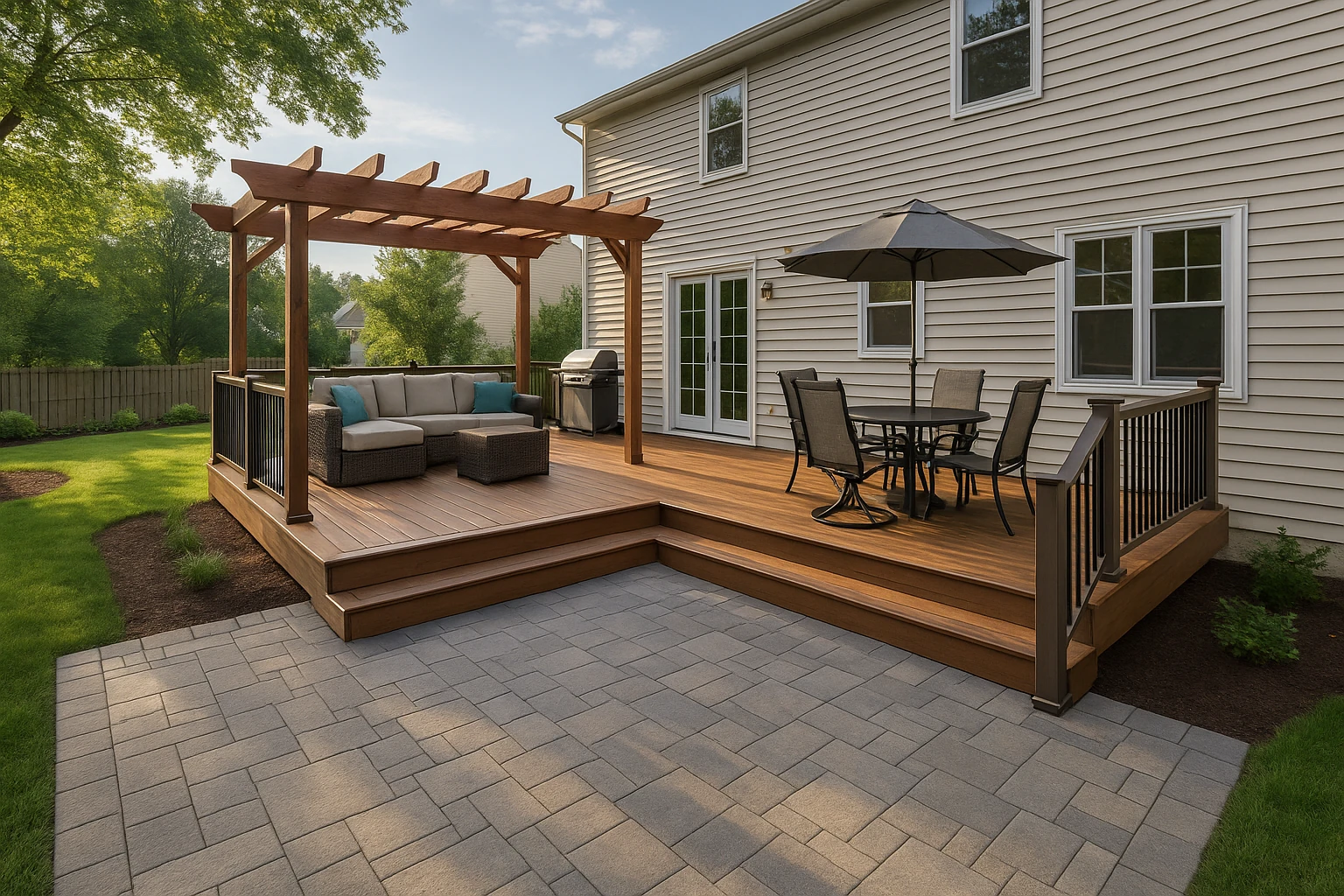
Let's put real numbers on a 300-square-foot deck, which is a common size for a KC backyard. Build a pressure-treated pine deck for around $6,000. Then plan on staining and sealing it every 1-2 years at $600-$1,200 per cycle. Over 10 years that's easily $4,000-$6,000 in upkeep, plus replacing a few boards that the freeze-thaw cycle chewed up. Your "cheap" deck just crossed $10,000.
Build that same 300-square-foot deck in composite for around $13,000 and your ongoing cost is essentially a couple bags of soap and an afternoon with a hose each year. Ten years in, you've spent close to nothing beyond the build, and the deck looks the same as the day we finished it. Twenty years in, the wood deck is on its way out and the composite is barely middle-aged.
That's why I tell people the upfront number is the wrong number to fixate on. The question is what the deck costs you per year of enjoyment, and over a long horizon composite is hard to beat. Over a short one, wood is the smart money.
Heat, Looks, and How KC Weather Plays In
Two factors trip up a lot of KC homeowners. First, heat. Composite absorbs and holds more heat than wood, and on a 95-degree July afternoon a dark board in full southern exposure can be uncomfortable barefoot. The fix is simple: choose a lighter color and a quality capped composite line, which run noticeably cooler. If your deck sits in shade or faces north, this barely matters.
Second, looks. There's no faking it, real cedar has a warmth and grain that even the best composite only approximates. If authentic wood is non-negotiable for you, cedar is the move and you accept the maintenance that comes with it. Today's premium composites look remarkably good, but a wood purist will always know.
Either way, KC's climate is the deciding backdrop. Our humid summers and freeze-thaw winters punish wood, which is exactly why composite has gotten so popular here. If you want real wood, I'll build you a beautiful custom wood deck and set you up to maintain it. If you're done with upkeep for good, our composite deck installation is built to handle decades of Missouri and Kansas weather.
Which Should You Choose?
Here's the verdict I give clients, based on budget and how long you'll stay:
Tight budget or selling soon
Pressure-Treated Pine
Lowest cost to build, strong resale ROI, fine if you won't own it for 15 years.
Want real wood, mid budget
Cedar
Natural beauty and cooler surface; commit to staining every 2-3 years.
Staying long-term
Composite
Highest upfront, lowest lifetime cost, and zero weekend maintenance.
Bottom line: If you'll own the home less than 7-8 years, wood usually makes more financial sense. If you're settling in for the long haul and never want to stain a deck again, composite is worth the upfront premium in KC's climate.
Frequently Asked Questions
Is a composite or wood deck cheaper in Kansas City in 2026?
Wood is cheaper upfront. Pressure-treated pine runs $15-$25 per square foot installed in Kansas City, cedar runs $25-$40, and composite runs $30-$60. But composite is usually cheaper over 10-15 years once you factor in staining, sealing, and board replacement that wood requires. If you are staying in your home long-term, composite often wins on total cost of ownership.
How long does a deck last in Kansas City weather?
In Kansas City's climate, a well-maintained pressure-treated pine deck lasts 10-15 years, cedar lasts 15-20 years, and quality composite (Trex, TimberTech, Fiberon) lasts 25-30+ years. Our hot, humid summers and freeze-thaw winters are hard on wood, causing cracking, warping, and rot faster than in milder climates. Composite is far more stable through those swings.
How much does it cost to stain and seal a wood deck?
Staining and sealing a wood deck in Kansas City typically costs $2-$4 per square foot when you hire it out, or about $150-$350 in materials if you do it yourself. Pressure-treated pine needs this every 1-2 years; cedar can stretch to every 2-3 years. Over 10 years, that maintenance can add $2,000-$6,000 to the lifetime cost of a 300-square-foot wood deck.
Does composite decking get too hot in the Kansas City sun?
Composite does retain more heat than wood, and on a 95-degree KC July afternoon a dark composite board in full sun can feel hot underfoot. Lighter colors and capped composite from premium lines stay noticeably cooler. If your deck faces full southern or western exposure, I usually recommend a lighter board color and planning for some shade.
What is the ROI on a deck in Kansas City?
According to Remodeling Magazine's Cost vs. Value report, wood deck additions consistently recoup 65-85% of their cost at resale, often outperforming composite on pure ROI because of the lower upfront price. Composite still adds strong resale appeal because buyers love low-maintenance outdoor space. In our Midwest market, both materials are a solid investment when built correctly.
How much does a 300 square foot deck cost in Kansas City?
For a 300-square-foot deck installed in Kansas City: pressure-treated pine runs roughly $4,500-$7,500, cedar runs $7,500-$12,000, and composite runs $9,000-$18,000. These are installed totals including framing, fasteners, and labor. Elevated decks, stairs, and railings push the numbers higher for any material.
Do composite decks need any maintenance?
Composite is low-maintenance, not no-maintenance. You will still sweep it, wash it with soap and water a couple times a year, and clear debris from between boards so it does not trap moisture. But you never stain, seal, or sand it. That eliminates the biggest ongoing cost and chore that wood decks carry.
Should I choose composite or wood for my deck?
Choose pressure-treated pine if you want the lowest upfront cost or plan to sell within a few years. Choose cedar if you want real wood beauty at a mid-range price and do not mind some upkeep. Choose composite if you are staying long-term and want to stop maintaining your deck for good. The right answer depends on your budget and how long you plan to enjoy the deck.
Ready to Build Your Deck?
Every backyard is different. The numbers in this guide give you a solid starting point, but your deck size, height, railing choices, and site conditions all shape the final price.
If you'd like a detailed quote for your project, we offer free consultations with no obligation. We'll walk your yard, talk through wood versus composite for your situation, and give you a realistic budget, usually within 24-48 hours.
About the Author
Bob Coulston, Owner of Coulston Construction
Bob is a 4th generation contractor who founded Coulston Construction 15 years ago. His team builds decks of every material across the Kansas City metro, from budget pressure-treated builds to premium composite installations. The company maintains a 5.0 Google rating with 500+ reviews and an A+ BBB rating.
Learn more about Bob →