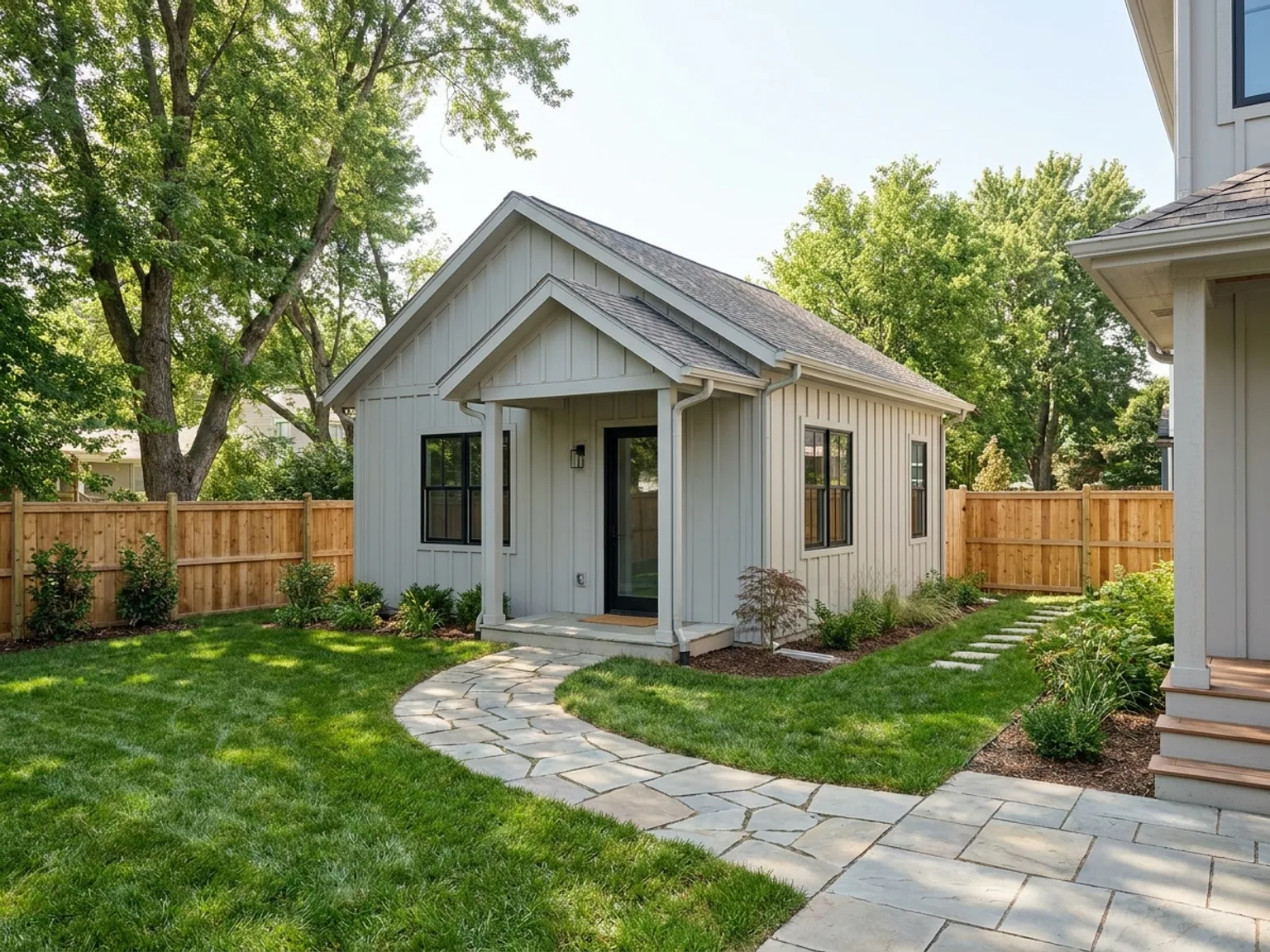
Key Takeaways
- $50,000-$110,000: Basement ADU (cheapest, since the shell already exists)
- $60,000-$130,000: Garage conversion ADU
- $100,000-$200,000: Attached in-law suite addition
- $150,000-$300,000: Detached backyard ADU (new construction)
- KCMO rules: ADUs legal citywide (Ordinance 220698), but the owner must live on the property
- Rental math: KC one-bedrooms rent for roughly $1,100-$1,400/month
For sixty years, Kansas City zoning effectively banned the backyard cottage, the garage apartment, and the basement flat. That changed when the City Council passed Ordinance 220698 and re-legalized accessory dwelling units citywide. Since then, ADU questions have gone from rare to weekly at our office.
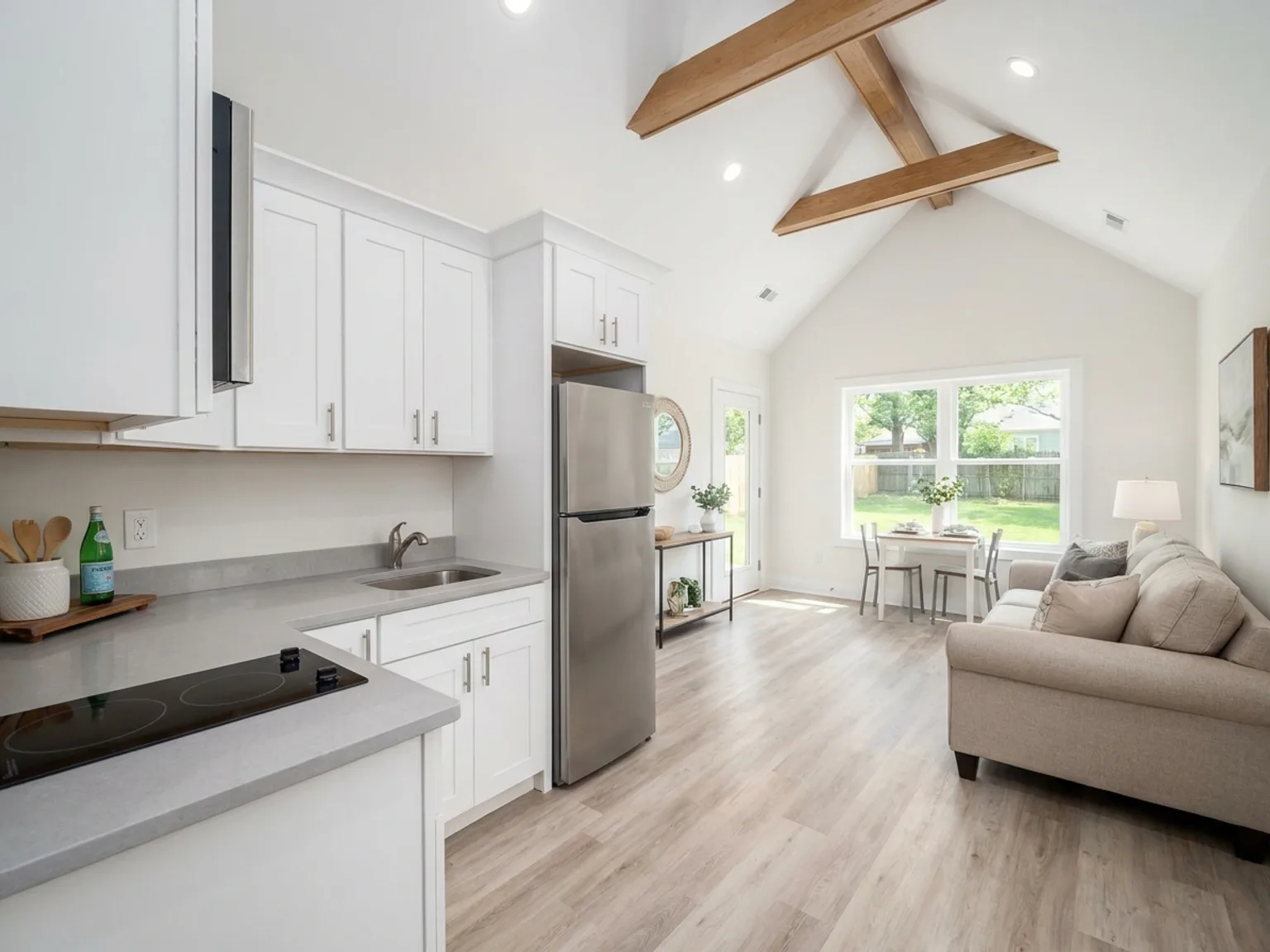
An ADU, sometimes called an in-law suite, granny flat, or carriage house, is a second, self-contained home on your lot: its own kitchen, bathroom, sleeping area, and entrance. Families build them for aging parents who want independence without distance, for adult kids saving for a down payment, and increasingly as long-term rentals that generate real income.
In this guide I'll walk through what each type of ADU actually costs to build in the Kansas City metro, the KCMO rules you must follow, how the Kansas-side suburbs differ, and the rental math that makes these projects pencil out.
ADU Cost by Type in Kansas City
The biggest cost driver is how much structure already exists. A basement has a foundation, roof, and walls; a backyard has grass. Here's what each path costs, fully finished and permitted:
Basement ADU
$50,000 - $110,000The most affordable ADU in Kansas City, because most of our housing stock already has a full basement. You're adding a kitchen, a bathroom, an egress window or separate entrance, and sound separation, not a building. National data pegs basement conversions around $117 per square foot, and KC tracks slightly below that.
Typical scope:
- • Kitchenette or full kitchen
- • Full bathroom, laundry hookup
- • Egress windows + separate entrance
- • Sound insulation between floors
Timeline
2-4 months of construction
Best for
Budget-conscious owners and rental income starters
Garage Conversion ADU
$60,000 - $130,000A two-car garage is roughly 400-575 square feet, a perfect studio or one-bedroom footprint, and the shell is already standing. Attached garages convert cheapest; detached garages add 20-30% because water, sewer, and electric have to be trenched out to the building.
Typical scope:
- • Insulate slab, walls, and ceiling
- • Replace garage door with wall/windows
- • Kitchen, bath, mini-split HVAC
- • Utility runs (bigger cost if detached)
Timeline
2-4 months of construction
Best for
Owners who don't use the garage and want real separation
Attached In-Law Suite Addition
$100,000 - $200,000A new wing built onto the house, typically 400-800 square feet with a bedroom, bathroom, sitting area, and kitchenette, often with a private entrance. At $150-$250 per square foot it costs more than a conversion, but it's new space designed exactly for its purpose, frequently with aging-in-place features like zero-step entries and curbless showers.
Typical scope:
- • Foundation, framing, roof tie-in
- • Bedroom, full bath, kitchenette
- • Private entrance, accessibility features
- • Extends existing HVAC or adds a zone
Timeline
4-6 months of construction
Best for
Multigenerational families who want connection plus privacy
Detached Backyard ADU
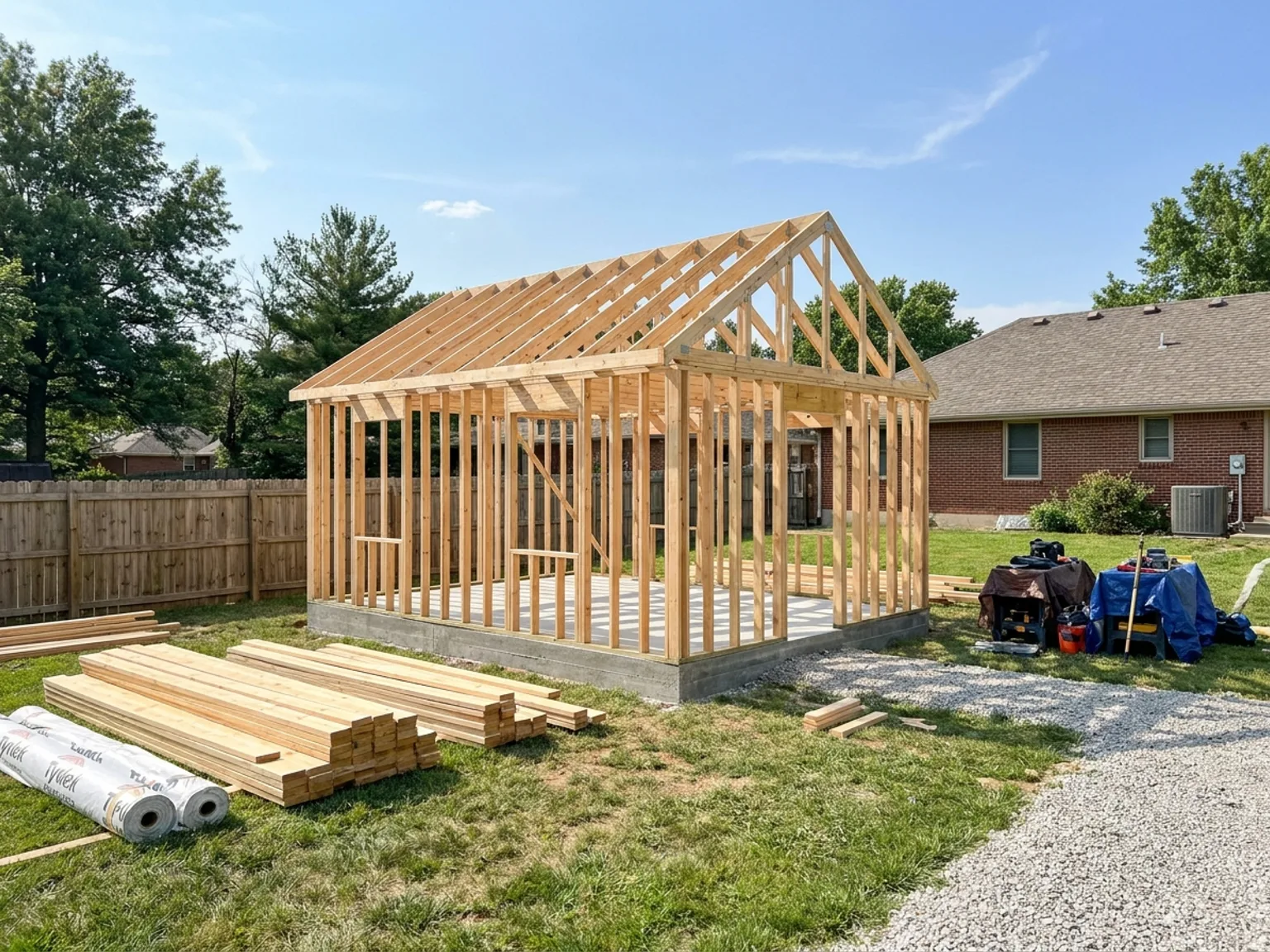
$150,000 - $300,000A brand-new small house in the backyard: its own foundation, roof, utilities, and address-quality privacy. Nationally these run $200-$400 per square foot; Kansas City's lower labor costs keep most local builds in the $180-$300 range. It's the most expensive option and also the one that rents best and adds the most value.
Typical scope:
- • 400-900 sq ft new construction
- • Full kitchen, bath, laundry
- • Trenched water, sewer, electric
- • Full permit + inspection cycle
Timeline
5-8 months of construction
Best for
Maximum privacy, rental income, and long-term value
If the garage route interests you, we've priced it out in detail in our garage conversion cost guide, including what changes when the garage is detached. And for a broader look at adding new square footage of any kind, see our room addition cost per square foot guide.
ADU Costs at a Glance
Here's the full comparison in one table. Ranges assume a finished, permitted, code-compliant unit in the Kansas City metro:
| ADU Type | Typical Cost | Per Sq Ft | Total Timeline |
|---|---|---|---|
| Basement ADU | $50,000 - $110,000 | $75 - $140 | ~6 months |
| Garage conversion | $60,000 - $130,000 | $120 - $230 | ~6 months |
| Attached in-law suite | $100,000 - $200,000 | $150 - $250 | 7-9 months |
| Detached ADU | $150,000 - $300,000 | $180 - $300 | 8-12 months |
For a sanity check against national numbers, Angi's ADU cost data puts the national average around $180,000 with most projects between $40,000 and $360,000, and Building an ADU's cost research is the best deep dive I've found on why quotes vary so widely. Kansas City's labor market sits comfortably below the coastal cities that dominate those averages.
Kansas City ADU Rules: What Ordinance 220698 Allows
Kansas City, Missouri's ADU ordinance reversed a decades-old prohibition and made ADUs a permitted accessory use in residential districts. The full text lives in Section 88-305 of the KCMO zoning code, but here are the rules that actually shape projects:
Owner-occupancy is required. The property owner must live on the lot, in either the main house or the ADU. This is the rule that surprises investors: you can't add an ADU to a pure rental property and lease both units.
One ADU per lot, secondary in size. The unit must be clearly subordinate to the primary dwelling, and size, height, and setback limits vary by zoning district. Lot minimums (generally around 5,000 square feet with 50 feet of width for detached units) rule out some smaller urban lots, so verify your parcel with City Planning early.
Full permits and code compliance. An ADU is a dwelling, so it needs building, electrical, plumbing, and mechanical permits and must meet the residential code: egress, ceiling heights, smoke/CO detection, and proper kitchen and bath ventilation. Plan review typically takes 4-12 weeks and permit fees run roughly $1,500-$5,000 for a standard project. Basement units converted "quietly" without permits can't legally be rented and become a problem at resale.
Rentals are allowed, with a catch. Long-term rental of a permitted ADU is fine. Short-term rental (Airbnb-style) is regulated separately and requires registration under KCMO's short-term rental rules.
Parking. Off-street parking requirements depend on the district and unit size; an existing driveway often satisfies them, but confirm before you design a detached unit that eats your parking pad.
What About Johnson County and the Kansas Side?
The metro is a patchwork. Unincorporated Johnson County allows ADUs through an administrative review process, and Olathe permits them up to 1,000 square feet or 50% of the primary home's floor area, whichever is less. Overland Park and several other Johnson County cities remain more restrictive, and rules are actively evolving as the region pushes for more housing options. The Mid-America Regional Council's ADU resource page tracks which metro communities allow them and links to example ordinances. The practical advice: on the Kansas side, call your city's planning department before you spend a dollar on design. We handle that verification for our clients as step one.
The Rental Income Angle
Here's the math that makes ADUs interesting as more than family housing. A one-bedroom unit in Kansas City rents for roughly $1,100-$1,400 per month depending on neighborhood and finish level. That's $13,000-$17,000 per year. Against a $90,000 basement or garage conversion, gross rent alone can recover the build cost in six to eight years, and the finished square footage adds appraised value on top.
The same unit also works in sequence: house a parent for some years, then convert to a rental, then offer it to an adult child, then use it to age in place yourself while renting the main house. That flexibility is why planners and lenders have warmed to ADUs, and why a permitted, code-built unit is worth far more than an informal basement apartment.
Smart Places to Save
- Use existing structure – Basement or garage beats new construction by $100K+
- Stack the wet walls – Put the ADU kitchen/bath near existing plumbing
- Kitchenette over full kitchen – A 24" range and compact fridge save thousands
- Mini-split HVAC – Cheaper than extending ductwork to a conversion
- Simple rectangular footprint – For detached builds, corners cost money
Never Cut Corners On
- Permits – An unpermitted ADU can't legally be rented and haunts resale
- Egress – Bedroom windows and exits are life-safety code, not suggestions
- Sound separation – Insulation between units makes or breaks livability
- Utility capacity – Verify your electrical service and sewer can handle a second household
Permits deserve their own conversation, and we've written one: our Kansas City building permits guide walks through the process, timelines, and fees city by city. And if you're leaning toward the attached suite route, our in-law suite addition page shows recent builds with private entrances and accessibility features.
Frequently Asked Questions
Are ADUs legal in Kansas City?
Yes. Kansas City, Missouri legalized accessory dwelling units citywide with Ordinance 220698, reversing decades of zoning policy that had effectively banned them. Homeowners in residential districts can now build an internal, attached, or detached ADU, subject to owner-occupancy, lot, and size rules. On the Kansas side, rules vary by city, so check with your local planning department before designing anything.
How much does an ADU cost to build in Kansas City in 2026?
In the Kansas City metro, a basement ADU typically runs $50,000-$110,000, a garage conversion $60,000-$130,000, an attached in-law suite addition $100,000-$200,000, and a detached backyard ADU $150,000-$300,000. Nationally, ADUs average $150-$300 per square foot; KC labor rates keep most local projects toward the lower half of national ranges.
What is the cheapest type of ADU?
A basement ADU is almost always the cheapest, because the foundation, roof, and shell already exist. In Kansas City, where most homes have full basements, converting one into a legal secondary unit with a kitchen, bathroom, and egress typically costs $50,000-$110,000, roughly half the cost of building the same square footage detached.
Do I have to live on the property to have an ADU in Kansas City?
Yes. Kansas City’s ordinance requires the property owner to live on the lot, in either the main house or the ADU itself. You cannot buy a house, add an ADU, and rent out both units as an absentee landlord. This owner-occupancy rule is one of the most important constraints to understand before you invest.
Can I rent out my ADU in Kansas City?
Yes. Long-term rentals of a permitted ADU are allowed as long as the owner lives on the property. Short-term rentals (Airbnb/VRBO) are treated separately and require registration under Kansas City’s short-term rental regulations, which are stricter. Most of our clients build for long-term tenants or family members.
How big can an ADU be in Kansas City?
An ADU must be clearly secondary to the main house, and size limits depend on your lot and zoning district. Metro-area ordinances generally cap ADUs relative to the primary dwelling; Olathe, for example, caps them at 1,000 square feet or 50% of the main home, whichever is less. Most of the ADUs we build run 400-900 square feet. Verify your specific lot with City Planning before finalizing a design.
How long does it take to build an ADU?
Plan on 2-4 months for design, drawings, and permits (Kansas City plan review typically takes 4-12 weeks), then 2-4 months of construction for a basement or garage conversion and 5-8 months for a detached new build. All in, a conversion commonly takes about 6 months and a detached ADU 8-12 months from first sketch to occupancy.
Does an ADU add value to my home?
Generally yes, especially now that KCMO has legalized them. A permitted ADU adds finished, rentable square footage, and appraisers increasingly credit the income potential. A unit renting for $1,100-$1,400 per month, typical for a KC one-bedroom, generates $13,000-$17,000 a year, which can offset a large share of the construction loan payment.
Ready to Get Started?
An ADU is a real construction project with real zoning homework, which is exactly why the first step matters: verify what your lot allows, then design to the budget. As experienced ADU contractors in the Kansas City metro, we handle both sides, from the planning department phone calls to the final inspection.
If you're weighing a basement suite against a backyard build, we offer free consultations with no obligation. We'll look at your lot, talk through the rules that apply, and give you a realistic budget range. Call (816) 365-9308 or use the form below.
About the Author
Bob Coulston, Owner of Coulston Construction
Bob is a 4th generation contractor who founded Coulston Construction 15 years ago. His team of 30+ employees has built in-law suites, garage conversions, and basement apartments across the Kansas City metro, guiding families through zoning, permits, and construction. The company maintains a 5.0 Google rating with 500+ reviews and an A+ BBB rating.
Learn more about Bob →